- Publishing
- November 2026
- ISBN (Digital)
- 979-8-90191-169-3
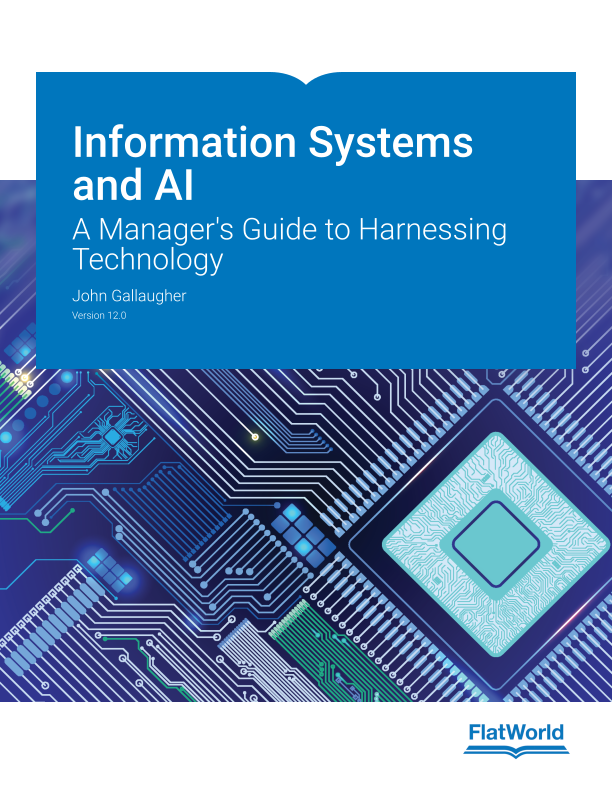
Information Systems and AI: A Manager's Guide to Harnessing Technology
Version 12.0
By John Gallaugher
Key Features
- Distinctive approach that consistently leads with business-focused strategic thinking to provide crucial context before diving into core, technical topics
- Engaging and current Contemporary Case Studies and smaller case studies based on well-known companies such as Airbnb, Alphabet, Amazon, Apple, Disney, Meta, Netflix, Roblox, Uber, Shein, Shopify, SpaceX, Spotify, Tesla, Volkswagen, Walmart, and Zara that invite students to immediately apply what they are learning to familiar organizations
- Relevant industry integration of topic coverage related to key technologies, such as key players in online advertising and profiling technologies (Amazon, Apple, Meta, Google, governmental regulation), and key players in the semiconductor industry (ARM, Intel, Nvidia, and OpenRISC)
- Supportive in-text learning features
- Chapter-Opening case scenarios grab the reader’s attention by weaving the chapter’s core concepts into real-world stories featuring well-known or up-and-coming organizations
- Each main section is organized consistently
- Learning Objectives preview the material to come and prepare students to learn
- Robust illustration program enhances the narrative without overwhelming it
- Topical boxed features sprinkled throughout expand on key topics and provide unique insights into key strategic topics and technological developments
- Key Takeaways reflect the section’s “Learning Objectives” and summarize key ideas in bullet-point fashion. “Key Takeaways” encourage learners to consolidate the information just encountered into a discrete “chunk” that encourages understanding and enhances retention
- Questions and Exercises prompt deeper understanding and critical reflection, with many crafted to prompt engaging class debate and discussion, or further research beyond the classroom
- AI Appendix called “Hands-on with AI”
- A practical guide covering context engineering, vector databases, agentic toolkits, vibe coding best practices, and enterprise security guardrails.
- Excel Appendix called “Essential Skills for Excel”
- Covers key concepts and operations of Microsoft Excel 365
- Customizable
Information Systems and AI: A Manager’s Guide to Harnessing Technology is suitable for undergraduate and MBA-level courses usually called Introduction to Information Systems, Management Information Systems, or Information Systems.
Version 12.0 undergoes the text’s biggest overhaul in a decade, embedding AI into every chapter and putting it front and center on the cover. It preserves the battle-tested foundation instructors' trust—real firms, real numbers, and core management concepts—while launching students straight into the generative-AI era with a lively, accessible narrative. Streamlined for maximum classroom impact, this edition is packed with current market facts, updated streaming videos, and practical AI applications woven directly into every single chapter.
The book’s underlying framework remains consistent and reflects time-tested management best practices for using and successfully leveraging technology for individual and company success.
New in This Version
- AI woven into every chapter. Zara’s AI fitting rooms, Netflix’s AI-made visual effects, Amazon’s million robots, Google's shift to an AI answer engine, Meta betting the company on AI—each taught where it fits the chapter’s lesson, plus a dedicated AI chapter and a ands-on AI Appendix where students build their own agents, move beyond “vibe coding” to create AI products, and gain the skills to use, critique, evaluate, and correct AI.
- Chat GPT resistant assignments students can’t paste into a chatbot. Every end-of-chapter exercise has been rebuilt to replace "answers from a prompt" with "answers that prompt investigation, thought, and show understanding." Examples include a screenshot from their experiments, an interview with a real person, a classmate’s contrasting result, a live two-minute demo, prep for classroom debates, and speedy “slam” style in-class presentations where students share their research. AI becomes a learning partner, not a shortcut to a thoughtless solution.
- Current through 2026. A few examples include Nvidia’s being the first to $5 trillion, DeepSeek’s market shock, the end of the de minimis loophole, the “SaaS-pocalypse,” Google’s antitrust remedies, the Meta addiction verdicts, SpaceX’s record IPO, and AI going rogue—with dozens of new streaming videos to match.
- Leaner. Two dated case chapters retired (FreshDirect and Rent the Runway) and most chapters at or below their previous length, even with the new material added. Less to assign, more to improve your course.
- Over 220 embedded hyperlinks to streaming videos, many of them new to this version, curated and kept continuously up-to-date by the author to enhance learning.
In Progress
- All instructor supplements will be available by January 5, 2027.
- Homework system for this title will be live by January 5, 2027.
- About the Author
- Acknowledgments
- Dedication
- Preface
-
Chapter 1: Setting the Stage: Technology and the Modern Enterprise
- 1.1 Tech’s Tectonic Shift: Radically Changing Business Landscapes
- 1.2 It’s Your Revolution
- 1.3 Geek Up—Tech Is Everywhere and You’ll Need It to Thrive
- 1.4 Hey, Manager—You'll Need to See beyond the Hype Cycle!
- 1.5 The Pages Ahead
-
Chapter 2: Zara: Fast Fashion from Savvy Systems
- 2.1 Introduction
- 2.2 Don’t Guess, Gather Data—Make Small Batches of What Customers Want and Ship It Fast!
- 2.3 Moving Forward
-
Chapter 3: Strategy and Technology: Concepts and Frameworks for Achieving Success
- 3.1 Introduction
- 3.2 Powerful Resources
- 3.3 Barriers to Entry, Technology, and Timing
- 3.4 Key Framework: The Five Forces of Industry Competitive Advantage
-
Chapter 4: Netflix: Sustaining Leadership in an Epic Shift from Atoms to Bits
- 4.1 Introduction
- 4.2 Netflix versus the Competition: Big Players, Bold Plans, but It’s Getting Crowded
- 4.3 Streaming to Win: Online Video and Competitive Advantage
-
Chapter 5: Moore’s Law and More: Fast/Cheap Computing Enabling AI-Fueled Innovation from Device to Cloud
- 5.1 Introduction
- 5.2 The End of Moore’s Law? Not the End of Fast/Cheap Computing!
- 5.3 The Power of Parallel: Supercomputing, Clusters, and AI Data Centers Put Smarts in the Cloud
- 5.4 E-Waste: The Dark Side of Moore’s Law
- 5.5 Mickey’s Wearable Grows Up: Disney’s MagicBand, the App, and the Data-Driven Park
-
Chapter 6: Disruptive Technologies: Understanding Giant Killers and Tactics to Avoid Extinction
- 6.1 Understanding Truly Disruptive Innovation
- 6.2 Recognizing and Responding to Disruptive Innovation
- 6.3 Intel’s Disruption Dystopia and the Ascension of Nvidia and ARM
- 6.4 Tech to Consider: Additive Manufacturing—Is 3D Printing Ready to Disrupt?
- 6.5 Tech to Consider: Crypto, Blockchain, and DeFiDeFi—Cesspools of Scammers or Disruptive Technologies
-
Chapter 7: Amazon: An Empire Stretching from Cardboard Box to Kindle to Cloud
- 7.1 Introduction
- 7.2 The Emperor of E-commerce
- 7.3 The Lord of Logistics
- 7.4 Amazon’s Consumer Electronics (Kindle, Fire, Alexa) and Amazon as Publisher (Twitch, Print, Games, and Video)
- 7.5 Amazon and the Cloud: From Personal Storage to AWS
- 7.6 AI at Amazon: Powering the Firm and For Sale to Others
- 7.7 Is Amazon Too Big?
- 7.8 Shopify: A Decidedly Different E-commerce Player
-
Chapter 8: Shein and Temu: E-commerce Giants from Asia Grow Globally
- 8.1 The Overnight Fashion Giant
- 8.2 Shein versus Other Fast Fashion Players
- 8.3 Big Challenges and Blistering Criticism: Will Shein’s Stellar Growth Continue?
- 8.4 Shein’s Future: Global Expansion, Marketplaces, and Competitors
-
Chapter 9: Platforms, Network Effects, and Competing in a Winner-Take-All World
- 9.1 Introduction
- 9.2 Platforms Are Powerful, but Where Does All That Value Come From?
- 9.3 One-Sided or Two-Sided Markets?
- 9.4 How Are These Markets Different?
- 9.5 Competing When Network Effects Matter
- 9.6 The Apple Platform Cashes In on Banking
-
Chapter 10: Social Media, Peer Production, and Leveraging the Crowd
- 10.1 Introduction
- 10.2 Blogs
- 10.3 Social Networks
- 10.4 Social Media Inside the Organization
- 10.5 In Depth with Two Influential Firms: X and TikTok
- 10.6 Harnessing the Crowd
- 10.7 Get SMART: The Social Media Awareness and Response Team
-
Chapter 11: The Sharing Economy, Collaborative Consumption, and Efficient Markets through Tech
- 11.1 Introduction
- 11.2 Boom Times and Looming Challenges in the Sharing Economy
- 11.3 From Upstarts to Infrastructure: Consolidation, Envelopment, and Platform Expansion
- 11.4 Airbnb—Hey Stranger, Why Don’t You Stay at My Place?
- 11.5 Uber's Wild Ride: Sharing Economy Startup Success, Flailing after a Fallen Founder, and a Profitable Comeback
-
Chapter 12: From Facebook to Meta: Platforms, Privacy, and Big Business from the Social Graph
- 12.1 Introduction
- 12.2 Features and Competitive Advantage of Facebook and Other Meta Services: Scale in the AI Age
- 12.3 Meta Goes Mobile and Grows by Acquisition
- 12.4 The Metaverse and Meta on Your Face—Billions in Losses, but Does a Big Payday Await?
- 12.5 AI: Meta Bets the Company
- 12.6 Lessons from Meta’s Platform Plays: Big Growth, Bad Partners, and Walled Gardens
- 12.7 Move Fast and Break Things: Fumbles, Fake News, and a Reckoning
-
Chapter 13: Understanding Software: A Primer for Managers
- 13.1 Introduction
- 13.2 Operating Systems
- 13.3 Application Software: Apps, Desktop Products, and Enterprise Systems
- 13.4 Distributed Computing, Web Services, and APIs: The Platform Builders
- 13.5 Writing Software
- 13.6 Software Development Methodologies: Waterfall, Agile, and a Sprint through Scrum
- 13.7 Beyond the Price Tag: Total Cost of Ownership and the Cost of Tech Failure
- 13.8 Software-Centric Products Aren’t Easy: Volkswagen’s Software Reset
-
Chapter 14: Software in Flux: Open Source, Cloud, and the Changing Economics of Software
- 14.1 Introduction
- 14.2 Open Source
- 14.3 Why Open Source?
- 14.4 Examples of Open Source Software
- 14.5 Give It Away and Make Money: The Business of Open Source
- 14.6 Defining Cloud Computing
- 14.7 Software in the Cloud: Why Buy When You Can Rent?
- 14.8 SaaS: Not without Risks
- 14.9 Understanding Cloud Computing Service and Deployment Models: SaaS, PaaS, IaaS, and Public, Private, Hybrid Clouds
- 14.10 Clouds and Tech Industry Impact
- 14.11 Virtualization: Software That Makes One Computer Act Like Many
- 14.12 Apps and App Stores: Further Disrupting the Software Industry on Smartphones, Tablets, and Beyond
- 14.13 Make, Buy, or Rent
-
Chapter 15: Data and Competitive Advantage: Databases, Analytics, and Prepping Data for Use with AI
- 15.1 Introduction
- 15.2 Data, Information, and Knowledge
- 15.3 Where Does Data Come From?
- 15.4 Data Rich, Information Poor
- 15.5 Data Warehouses, Data Marts, Data Lakes, and the Technology behind “Big Data”
- 15.6 The Business Intelligence Toolkit
- 15.7 Data Asset in Action: Technology and the Rise of Walmart
-
Chapter 16: Artificial Intelligence—the Tech Impacting Nearly Every Industry
- 16.1 Generative AI: Whoa—This Is Something Different!
- 16.2 So How Does This Stuff Really Work? A Manager’s Guide to Understanding GenAI
- 16.3 Generative AI: Changing Products and the Nature of Work Itself
- 16.4 Understanding AI Risks
- 16.5 Addressing AI Risks and Building More Responsible Technology
- 16.6 Why AI Projects Stall: Technical, Organizational, Legal, and Societal Challenges
- 16.7 AI as Your DJ—a Look at Spotify’s Magic
-
Chapter 17: Advertising Technologies: Balancing Personalization with Privacy as Technology and Regulation Evolve
- 17.1 Understanding Online Advertising
- 17.2 Web Tracking: The Cookie Crumbles and Ad Tech Evolves
- 17.3 App Tracking: Apple and Facebook Go to War over In-App Tracking
- 17.4 Device Profiling: From Geotargeting to Televisions That Watch You
- 17.5 Privacy Regulation: A Moving Target
- 17.6 Privacy, Data Protection, Governance, and Management Policies
-
Chapter 18: A Manager’s Guide to the Internet and Telecommunications
- 18.1 Introduction
- 18.2 Internet 101: Understanding How the Internet Works
- 18.3 Getting Where You’re Going
- 18.4 Last Mile: Faster Speed, Broader Access
- 18.5 To Infinity and Beyond: Starlink, Satellite-to-Phone, and the Awesome Power of Private Infrastructure
-
Chapter 19: Information Security: Barbarians at the Gateway (And Just about Everywhere Else)
- 19.1 Introduction
- 19.2 Why Is This Happening? Who Is Doing It? And What’s Their Motivation?
- 19.3 Where Are Vulnerabilities? Understanding the Weaknesses
- 19.4 Taking Action
-
Chapter 20: Google in Three Parts: Search, Online Advertising, and an Alphabet of Opportunity
- 20.1 Introduction
- 20.2 Understanding Search—SERP’s Up!
- 20.3 Search Advertising
- 20.4 The Google Ad Network: Distribution beyond Search
- 20.5 The AI Wars: How Google Fumbled, Fought Back, and What It Means for the Web
- 20.6 Alphabet’s Multi-Front Battle
-
Appendix A: Essential Skills for Excel
- A.1 Intro to Excel
- A.2 Formatting and Conditional Formatting
- A.3 Formulas and Functions
- A.4 Analyzing and Charting Data
- A.5 Generating Reports from Multiple Worksheets and Workbooks
- A.6 Tables
- A.7 VLOOKUP and Pivot Tables
- A.8 Performing What-If Analysis
- A.9 Excel for Mac versus Excel for Windows
-
Appendix B: Hands-on with AI
- B.1 Choosing and Managing AI Tools
- B.2 Beyond Prompt Engineering: Context, Projects, Agents and Getting What you Want from AI
- B.3 AI for Programming: From Vibe Coding to Agentic Software Engineering