- Publishing
- September 2026
- Page Count
- 816
- ISBN (Digital)
- 979-8-88794-735-8
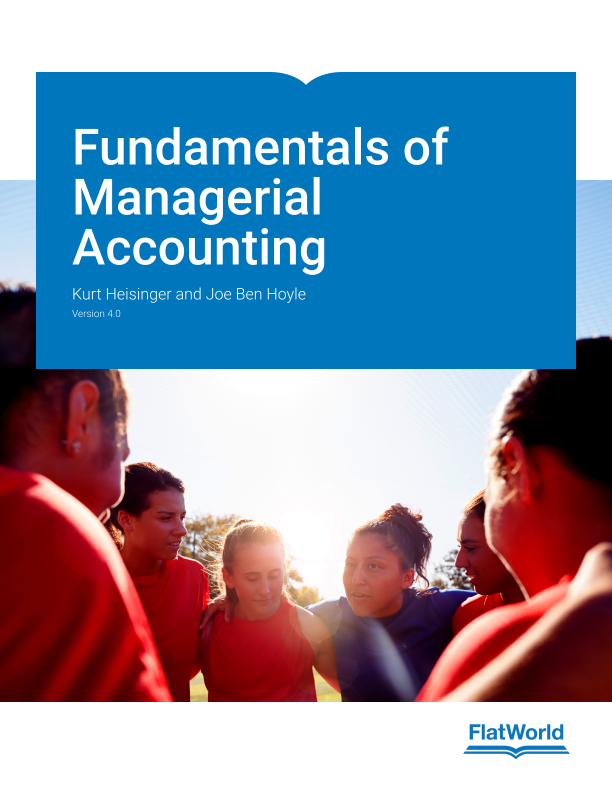
Fundamentals of Managerial Accounting



Version 4.0
By Kurt Heisinger and Joe Ben Hoyle
Included Supplements
 Manual
 Slides
 Tests
Tests

Key Features
- Each chapter starts with a realistic managerial scenario outlining an issue that must be addressed by the management accountant, followed by a modular chapter format built around learning objectives. Each learning objective includes:
-
- embedded author-recorded videos using examples directly from the text
- detailed descriptions of important concepts
- section summary aligned with learning objectives called "Key Takeaways"
- flashcards to help reinforce student learning
- quizzes to help students assess their knowledge
- active exercises with solutions called "Review Problems" that engage students in active learning and help them master key concepts, and
- extensive end-of-chapter questions, exercises, problems, and cases closely aligned with the material presented within each learning objective.
- Nearly 100 author-recorded video lessons directly tied to each section of the text enrich student learning and engagement. To provide consistency, videos use examples directly from the text and are embedded at the beginning of each learning objective section.
- A question-and-answer approach is used throughout text to stimulate critical-thinking skills.
- Essential topics are covered while maintaining academic rigor using a concise and jargon-free approach.
- Author-written supplementary materials provide robust instructional support and include an instructor’s manual, solutions manual, test bank, quizzes and flashcards embedded into the online reader version, PowerPoint lecture slides, student working papers, and online homework questions.
- Hyperlinks to companies and organizations are provided throughout the text to engage students with real-world applications of the concepts presented.
- The extensive instructor manual provides effective guidance for instructors teaching online, in-class, or hybrid courses.
- A free homework system is included that grades questions, furnishes feedback to students, and class statistics to instructors. Multiple versions of the same question are available to minimize student copying.
- The online Homework for v4.0 will include autogradable versions of the end-of-chapter exercises, including SmartGrader for Excel exercises where students complete Excel files and upload them to be autoscored.
- End-of-chapter assignments also include ethics cases, internet projects, group projects, real company analysis, and projects in Excel.
- Fully Customizable.
- Price: Online Access $37.95; Color Printed Textbook with Online Access $64.95
Students
- Online Access Price
- $37.95
- Color Printed Textbook with Online Access Price
- $64.95
Fundamentals of Managerial Accounting is suitable for introductory managerial accounting courses.
Precision meets practicality in Fundamentals of Managerial Accounting. This textbook offers a concise, high-impact approach to the core concepts every future manager needs. By following a logical scope and sequence, we help students bridge the gap between technical accounting and real-world organizational strategy.
The goal? To help accounting students move beyond the ledger and start thinking like a manager from day one, putting Business in Action.
New in This Version
- New SmartGrader for Excel included in the FlatWorld Homework system:
-
- Uses custom formatted Excel spreadsheets that provide guidance for students to complete and submit end-of-chapter homework
- Uses auto grading feature to facilitate homework assignment grading
- Integrates seamlessly with popular Learning Management Systems such as Canvas
- Allows for autograding of Excel files completed in Microsoft Excel
- Helps students learn the basics of using Excel for managerial accounting purposes
- Updated end-of-chapter content to reflect new and updated material within each chapter
- All ancillaries updated including Excel working papers, solutions manual, PowerPoint lecture notes, instructor's manual, and test bank
- Updated Business-in-Action (BIA) vignettes for the following:
- Planning and decision-making at Southwest Airlines, Apple, and Meta (BIA 1.1)
- Nonmanufacturing costs at PepsiCo (BIA 1.6)
- Product costs at Advanced Micro Devices (BIA 1.7)
- Production process at Coca Cola (BIA 4.1)
- Production process at Wrigley's Gum (BIA 4.2)
- Calculating full-time equivalent students (BIA 4.3)
- Production process for Hershey's chocolate (BIA 4.4)
- Controlling costs at United Airlines (BIA 5.1)
- Cost behavior patterns at Lowe's (BIA 5.3)
- Break-even price for oil companies (BIA 6.1)
- Cost of capital by industry (BIA 8.2)
- Controlling costs in the NBA (BIA 10.1)
- Segment reporting at Hewlett-Packard (BIA 11.2)
- Internal performance measures at General Electric (BIA 11.3)
- Cash flows at Southwest Airlines (BIA 12.1)
- Cash activity at Home Depot and Lowe's (BIA 12.2)
- Dividend payments and stock repurchases at Apple (BIA 12.4)
- Free cash flow at Amazon (BIA 12.5)
- Financial trends presented in annual reports (BIA 13.1)
- The importance of earning per share (BIA 13.3)
- Grocery store inventory and receivable turnover (BIA 13.4)
In Progress
- All instructor supplements will be available by September 30, 2026.
- Homework system for this title will be live by September 30, 2026.
- About the Authors
- Acknowledgments
- Dedication
- Preface
-
Chapter 1: How Is Managerial Accounting Used to Help Organizations?
-
Chapter 2: How Do Organizations Use Job Costing to Track Production Costs?
-
Chapter 3: How Do Organizations Use Activity-Based Costing to Allocate Overhead Costs?
-
Chapter 4: How Do Organizations Use Process Costing to Track Production Costs?
-
Chapter 5: How Are Cost Behavior Patterns Used to Predict Costs?
-
Chapter 6: How Is Cost-Volume-Profit Analysis Used to Make Decisions?
-
Chapter 7: How Are Relevant Revenues and Costs Used to Make Short-Term Decisions?
-
Chapter 8: How Is Capital Budgeting Used to Make Long-Term Decisions?
-
Chapter 9: How Do Organizations Create and Analyze Operating Budgets?
-
Chapter 10: How Is Cost Variance Analysis Used to Evaluate Performance?
-
Chapter 11: How Are Responsibility Centers Used to Evaluate Performance?
-
Chapter 12: How Is the Statement of Cash Flows Prepared and Used to Evaluate Performance?
-
Chapter 13: How Do Managers Use Financial and Nonfinancial Performance Measures?
-
Appendix A: Student Resources

Instructor’s Manual
The Instructor’s Manual guides you through the main concepts of each chapter and important elements such as learning objectives, key terms, and key takeaways. Can include answers to chapter exercises, group activity suggestions, and discussion questions.

PowerPoint Lecture Notes
A PowerPoint presentation highlighting key learning objectives and the main concepts for each chapter are available for you to use in your classroom. You can either cut and paste sections or use the presentation as a whole.

Solutions Manual
For exercises that need a little more explanation, our Solutions Manual will take you step by step through solving the problem and offer explanations on the answer.

Test Item File
Need assistance in supplementing your quizzes and tests? Our test-item files (in Word format) contain many multiple-choice, fill-in-the-blank, and short-answer questions.
Sample Syllabi
Sample syllabi provide useful templates to help new faculty adopters revise their teaching plans to match their assigned FlatWorld textbook or lend insights to existing adopters on how to organize their classes.

Other Supplements
Solutions manuals, sample exams, video learning segments, workbooks, cases and lab manuals are just some of the extras our books will offer depending on the needs of the course. Click here to see what this textbook offers.
At FlatWorld, we take pride in providing a range of high-quality supplements alongside our titles, to help instructors teach effectively. Supplements are available for instructors who have registered their adoption with us. If you need to review or preview something specific, please contact us.
Already registered? Sign in here.